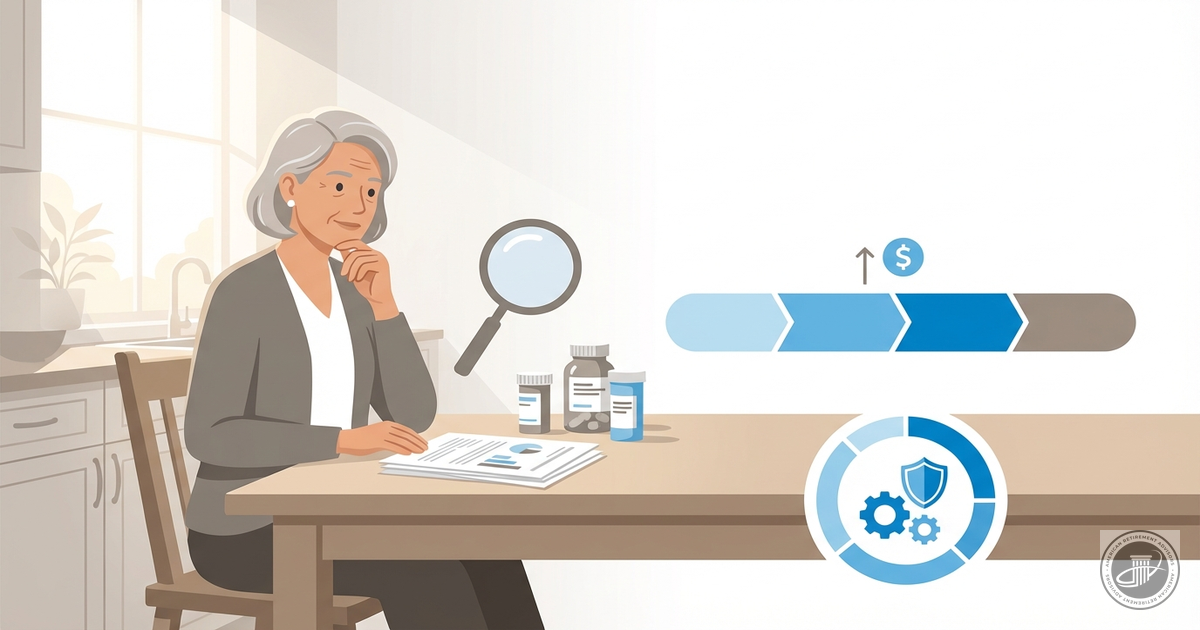
Every year around this time, the phone starts ringing, and the emails start coming as people are panicking over why the cost of their medication has skyrocketed. Most of the time there is a normal, yet frustrating, reason for this. Medicare prescription drug coverage, Part D, has different coverage phases that you may move through depending on the medications you're taking. This may not be something you remember speaking with your advisor about, because at the time it may not have applied to you. However, maybe you're taking new medication and it's more expensive, and so you're moving through those four Part D coverage phases. So, let's take a closer look at them.
The Four Coverage Phases
The first phase is called the deductible phase. During the deductible phase, if your plan has a deductible, you will pay the retail cost of the medication until the deductible is met. If your plan doesn't have a deductible, then it doesn't apply. Simple enough.
The second phase is called the Initial Coverage Limit or ICL. During this phase, you will pay the copays or coinsurance amounts set by your plan until the retail costs of your medications total up to $5,030 for 2024. This is not an amount that you are spending, in fact, it has nothing to do with what you are spending at all. This number represents the total of the retail costs of your medications for the year. For example, you are paying $40 for a medication with a retail cost of $600. They are counting the $600 toward your ICL. Once you reach the ICL, you move into the next phase.
The third phase is the dreaded "donut hole" or coverage gap. During that time, you pay 25% of the retail cost of your medication, leaving the plan to pay 5%, and the manufacturer to discount the remaining 70% for most medications anyway. It is during this time that you may see your drug costs skyrocket. If you are taking a drug that is $600 per month at retail, and you are paying a $40 copay, when you hit that donut hole, you will be paying $150 per month for that medication. You will pay that until you hit the true out of pocket maximum or TROOP. The TROOP includes everything YOU have paid all year as well as the discount that the manufacturer provided during the donut hole. Once that totals to $8,000 for 2024, you go into the last phase of Part D coverage.
The fourth phase is called catastrophic coverage. During this phase, you will pay coinsurance not to exceed 5% of the retail cost of the medication or small copays for your medications as set by Medicare. You should see the costs of your expensive medications drop significantly during this phase, but you may see the cost of your generic medications go up slightly.
The numbers cited above are for 2024 only and are set by Medicare each year. If you are taking more expensive brand or specialty medications, take heart and remember that starting in 2025, the amount you can spend for prescription medications is now capped at $2,000 per year.
As a side note, we are approaching our Annual Enrollment Period where changes can be made to your Medicare Advantage or Prescription Drug Plans. We'll be reaching out to ask you to update your information so we can review plan data and make sure you are on the right plan for the coming year. Even if nothing has changed, please fill out our online form because your plan may be changing.
We are all here to make your retirement journey 123Easy so do not hesitate to reach out to us. We are here for YOU!
By American Retirement Advisors
American Retirement Advisors helps retirees and pre-retirees navigate Medicare, estate planning, and retirement income — so you can enjoy the retirement you've earned.
You Might Also Like
- Think Again Before Ditching Your Drug Plan in Favor of a Drug Discount Card
Medicare & Healthcare · Tammy Semler - Prolia and Injectable Medications: Medicare Coverage Money-Saving Tips
Medicare & Healthcare · Sharon Groves - Did You Delay Part B? Then Watch for This Letter
Medicare & Healthcare · Tammy Semler
Easy Eddie's Take
The article explains those Medicare Part D coverage phases perfectly, and here's what I want you to know for 2024: that $2,000 out-of-pocket cap she mentioned is now in effect! This is huge news from the Inflation Reduction Act. Most people are surprised when they learn that even if you're in the coverage gap, you'll never pay more than $2,000 total for the entire year on prescription drugs.
One question that comes up all the time is "when exactly does Medicare's Annual Open Enrollment Period happen?" It runs from October 15th through December 7th every year, and that's when you can switch Medicare Advantage plans or standalone Part D prescription drug plans. The Centers for Medicare & Medicaid Services also allows a Medicare Advantage Open Enrollment Period from January 1st through March 31st, but your options are more limited then.
Here's my practical advice: if you're taking expensive medications and approaching that Initial Coverage Limit of $5,030, keep track of your spending through Medicare.gov or your plan's website. You'll get a much clearer picture of when you might hit the coverage gap and when that $2,000 cap kicks in to protect you. A little preparation today can make a big difference tomorrow.