Yesterday we left Harry Truman having lost. He proposed national health coverage in 1945, tried again in 1949, and both times the fight was decided less by argument than by a phrase. He left office with nothing to show for it.
Sixteen years later, the idea came back. And the campaign that rose up to stop it was so strange, so quiet, and so effective that it is still studied as a piece of political craft.
It arrived in the mail. On vinyl.
What was Operation Coffee Cup?
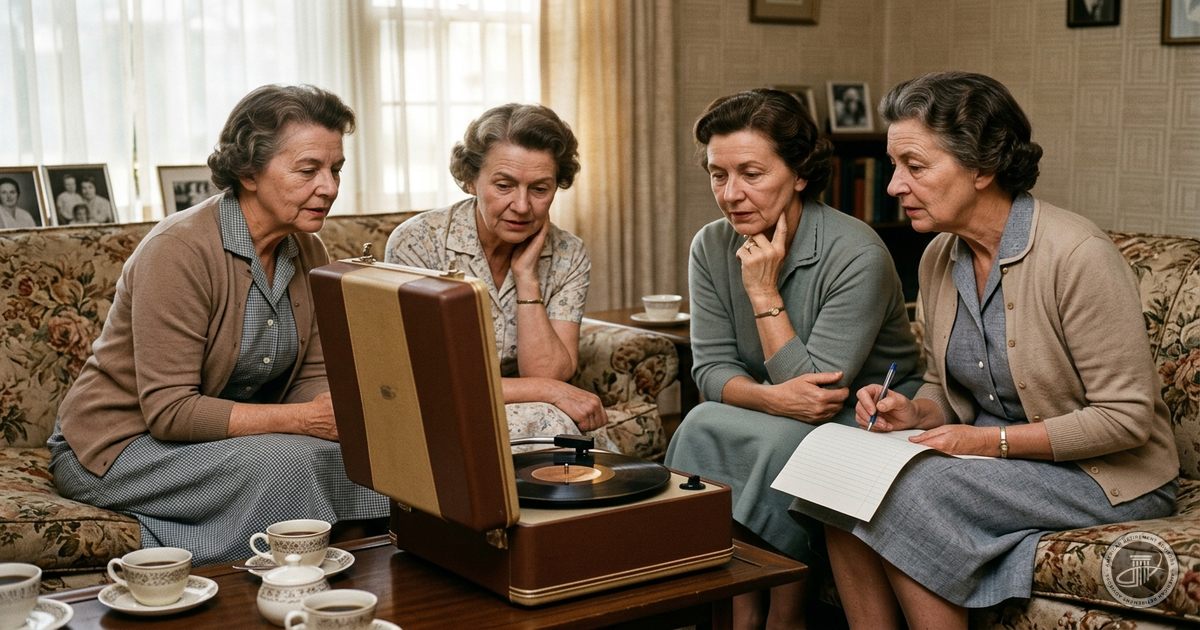
Operation Coffee Cup was a 1961 campaign run by the Woman's Auxiliary of the American Medical Association to defeat the Medicare bill then before Congress. Packets went out to doctors' wives around the country containing a phonograph record, a roster of senators and representatives, and instructions. The instructions were simple: invite your friends and neighbors over for coffee, play the record for them, and have them write to Congress before they leave your house.
The record was called Ronald Reagan Speaks Out Against Socialized Medicine, and a copy still sits in the library at the University of North Carolina, catalogued under the campaign's own name. Reagan was not a politician yet. He was an actor and a television host, and he recorded roughly ten minutes of argument for the AMA.
Sit with the design of that for a second, because it is genuinely brilliant.
There was no advertising buy. No television spots. The campaign never had to purchase a single minute of airtime, because the venue was somebody's living room and the host was a woman the guests already trusted. The record did the arguing. The neighbor provided the credibility. And the letter got written on the spot, while the coffee was still warm, before anyone had a chance to go home and think it over.
What was actually on the record
I want to state the opposing argument at its strongest, because this series is going to report this fight rather than join it, and because a caricature would not explain why it worked.
Reagan's case was not about medicine. It was about precedent. He argued that a government program aimed at one group was how a free country stops being free, one reasonable-sounding step at a time. He warned that it would not stop at the elderly, and that the same logic would eventually reach into other private decisions. In his words, as preserved in accounts of the recording, "pretty soon your son won't decide when he's in school, where he will go or what he will do for a living. He will wait for the government to tell him."
He closed with the line people still quote:
"We are going to spend our sunset years telling our children and our children's children what it once was like in America when men were free."
Whatever you think of the argument, notice what it is doing. It never asks the listener to weigh hospital coverage against its cost. It asks her to picture her grandchildren living in a country she would not recognize. That is a much larger thing to be afraid of than a bill, and it is not the kind of fear a policy debate can answer.
The other side had a president and an arena
The supporters were not passive. Organized labor ran dozens of rallies across the country in the spring of 1962, and on May 20 President Kennedy stood in Madison Square Garden in front of a crowd of about twenty thousand older Americans and made the case himself.
A sitting president. A packed arena in New York. National coverage.
And it lost.
The bill's opponents prevailed, narrowly defeating it in 1962 according to the Senate's own history of the program. The coalition against it included the American Medical Association, the chairman of Senate Finance, and the chairman of House Ways and Means, who becomes very important tomorrow.
So here is the scoreboard from that round. The arena lost. The living rooms won.
Kennedy's own aide, Larry O'Brien, put his finger on exactly why, and his line has been quoted by historians ever since: you do not persuade the chairman of Ways and Means with a rally in Madison Square Garden. Twenty thousand people in a building is a photograph. Ten thousand handwritten letters arriving from your own district is a problem.
The part almost nobody knows
Here is where the story does something I did not expect when I started reading for this week.
Ronald Reagan became President of the United States. And on July 1, 1988, he signed the Medicare Catastrophic Coverage Act, the largest expansion of Medicare benefits since the program was created. His remarks that day are still on file at his own presidential library.
I am not offering that as a gotcha, and I would ask you not to take it as one. People are allowed to arrive somewhere different than where they started, and a man who spends twenty-seven years watching a program operate has information he did not have when he stepped up to a microphone in 1961.
What it actually shows is how completely the argument ended. The idea that was mailed to living rooms as a warning about the end of freedom became, within a generation, so ordinary that its most famous opponent signed its expansion into law. That is not a story about who won. It is a story about how something contested becomes something assumed.
That expansion, by the way, did not survive the year. Congress took it back, and the reason why is one of the strangest things in this entire history. That is Friday.
Tomorrow, though, we finally meet the man who had been quietly strangling this bill for years, and who then did something nobody in Washington saw coming. He took his opponents' own proposal, the one written specifically to kill Medicare, and made it half the program. That story publishes tomorrow at 10:30 AM ET.
And if you are approaching 65, or helping a parent through it, the choices that arrive with that card are more permanent than most families expect. The team at American Retirement Advisors walks people through it as part of every plan, at no cost to you. Call (602) 281-3898.
Continue the Series
Next: The Man Who Blocked Medicare for Years, Then Built It in One Night →Disclaimer: The information in this article is for educational purposes only and does not constitute tax, legal, or investment advice. Tax laws change frequently, and individual circumstances vary. American Retirement Advisors does not provide tax or legal services. Before making any tax-related decisions, consult a qualified CPA, tax attorney, or financial planner who can evaluate your specific situation.