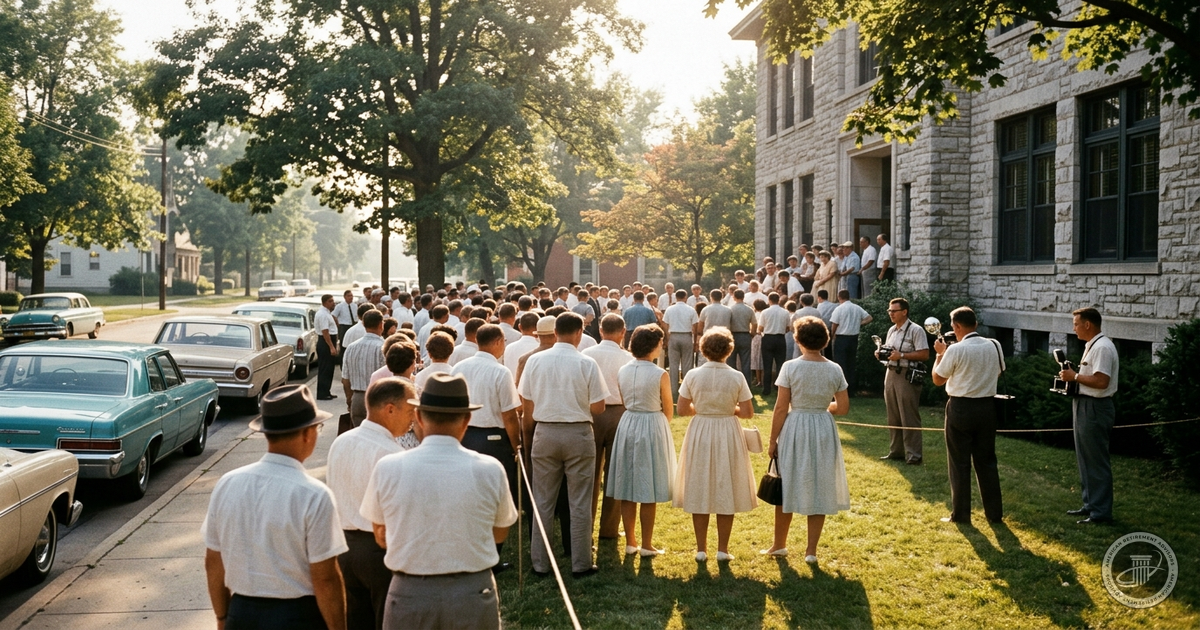
Sixty-one years ago today, on July 30, 1965, Medicare became law. And the most remarkable thing about that afternoon is where it did not happen.
It did not happen in Washington.
Lyndon Johnson got on a plane, flew to Independence, Missouri, and signed the bill at 2:55 in the afternoon in the auditorium of the Harry S. Truman Library, with Harry and Bess Truman sitting beside him. He had come to hand the thing to the man who lost it.
Why was Medicare signed in Independence, Missouri?
Medicare was signed at the Truman Library because Lyndon Johnson wanted to credit Harry Truman with starting the fight twenty years earlier. Truman had proposed national health coverage in 1945, been beaten, tried again in 1949, and been beaten worse. Johnson flew to his hometown to finish it in front of him, and then enrolled him as the first Medicare beneficiary in the country.
If you have been with us since Monday, you know exactly how much that costs a man.
What Truman had said, twenty years earlier
We opened this week with a sentence Truman wrote in his message to Congress on November 19, 1945. He could see the attack coming and tried to disarm it before anyone swung:
"They will not be frightened off from health insurance because some people have misnamed it 'socialized medicine'. I repeat, what I am recommending is not socialized medicine."
They were frightened off. The phrase did exactly what he feared. He lost in 1945, lost again in 1949 against the most expensive lobbying campaign in American history to that point, and walked out of the White House in 1953 with nothing to show for it.
He was eighty-one years old on the afternoon Johnson came to Missouri.
What Johnson said in that room
Johnson could have taken the win. Presidents usually do. Instead he stood up in another man's library and gave it away, according to the transcript of his remarks.
"But it all started really with the man from Independence. And so, as it is fitting that we should, we have come back here to his home to complete what he began."
And then, about Truman himself:
"But it was really Harry Truman of Missouri who planted the seeds of compassion and duty which have today flowered into care for the sick, and serenity for the fearful."
Serenity for the fearful. A president wrote that down and said it out loud about a program, and I have not been able to stop thinking about it all week.
The sentence that is the whole reason we did this series
Then Johnson described what the thing actually does. Read this slowly, because the second half of it is the entire argument we have been building since Monday, and he said it in 1965.
"No longer will older Americans be denied the healing miracle of modern medicine. No longer will illness crush and destroy the savings that they have so carefully put away over a lifetime so that they might enjoy dignity in their later years. No longer will young families see their own incomes, and their own hopes, eaten away simply because they are carrying out their deep moral obligations to their parents, and to their uncles, and their aunts."
Their own incomes and their own hopes, eaten away, because they were taking care of their parents.
On Monday we said a single illness in old age used to destroy two generations at the same time: the parent's savings and the children's inheritance went into the identical hospital bill. That was not our framing. That was the thing everybody in 1965 understood the program to be for, stated by the president signing it, on the day he signed it.
Medicare was never really designed as a health program for the old. It was designed as a financial firewall between two generations.
Card number one
After the signing, Johnson enrolled Harry Truman as the first Medicare beneficiary in the United States and handed him the first card. Bess Truman received the second. Both cards are preserved at the LBJ Presidential Library.
Truman was eighty-one. He had been out of office for twelve years. He was not going to be the one to benefit from what this program would do over the next sixty years, and everybody in that auditorium knew it. The card was not a benefit. It was a receipt.
What he said in reply was brief:
"I am glad to have lived this long and to witness today the signing of the Medicare bill which puts this Nation right where it needs to be."
Glad to have lived this long.
What this week has actually been about
I did not know most of this story a month ago, and I have been in retirement planning my entire career.
Fifty-three years from a line in a party platform to a signature. A president who lost it. A record album mailed to living rooms to stop it. A committee chairman who blocked it for a decade and then built it in one night out of the bills written to kill it. And at the end, a man flying halfway across the country so the person who took the beating could be in the room.
Here is why any of that matters to a family sitting in one of our offices in 2026.
The card in your wallet is not an entitlement that appeared because government decided to be generous. It is the surviving result of a fifty-three-year argument that serious people on both sides believed they were right about. It was fought for, lost repeatedly, compromised into a strange three-part shape, and finally signed in the wrong city on purpose.
Things that hard to get are usually worth understanding.
Tomorrow we look at what Medicare did that almost nobody credits it for, including something in 1966 that changed American hospitals faster than a decade of court orders had managed. And a benefit expansion so unpopular that Congress repealed it within the year. That publishes tomorrow at 10:30 AM ET.
And if it has never been fully explained to you what your card does and where it stops, the team at American Retirement Advisors walks families through it as part of every plan, at no cost to you. Call (602) 281-3898. Sixty-one years is a long time to wait for something. It deserves to be understood.
Continue the Series
Next: The Three Things Medicare Did That Almost Nobody Gives It Credit For →Disclaimer: The information in this article is for educational purposes only and does not constitute tax, legal, or investment advice. Tax laws change frequently, and individual circumstances vary. American Retirement Advisors does not provide tax or legal services. Before making any tax-related decisions, consult a qualified CPA, tax attorney, or financial planner who can evaluate your specific situation.